Mixing & Mastering Tip #235 ·
What is intermodulation distortion (IMD) and how does it affect sound?

Ruslan Slatin
Mastering engineer at slatin.pro, Madrid
Intermodulation distortion (IMD) happens when two or more signals of different frequencies pass through a nonlinear system and interact to create new frequencies that weren’t in the original signal.
Here’s the mechanism.
Doing the math
A perfectly linear system just scales its input:
output = A × input
But real components (amplifiers, mixers, speakers, even air at high SPL) have a transfer function with higher-order terms:
output = A·x + B·x² + C·x³ + …
This is where things start getting spicy.
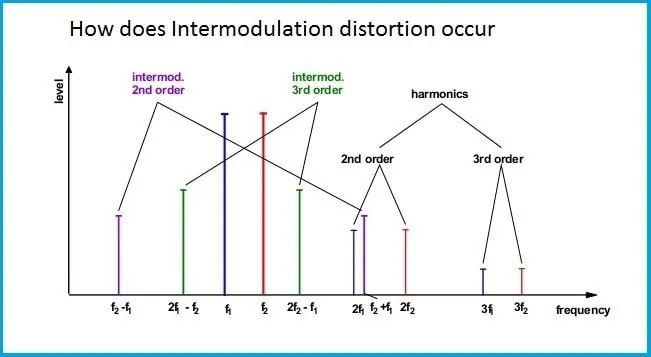
When you feed in two tones, say f1 and f2, those nonlinear terms do something nasty:
- The squared term (x²) creates sum and difference frequencies: f1 + f2 and f2 - f1.
- The cubed term (x³) creates the real troublemakers: 2f1 - f2 and 2f2 - f1.
These third-order products are the villains. They sit close to the original frequencies, which means you can’t filter them out without killing your actual signal.
Why it sounds dirty
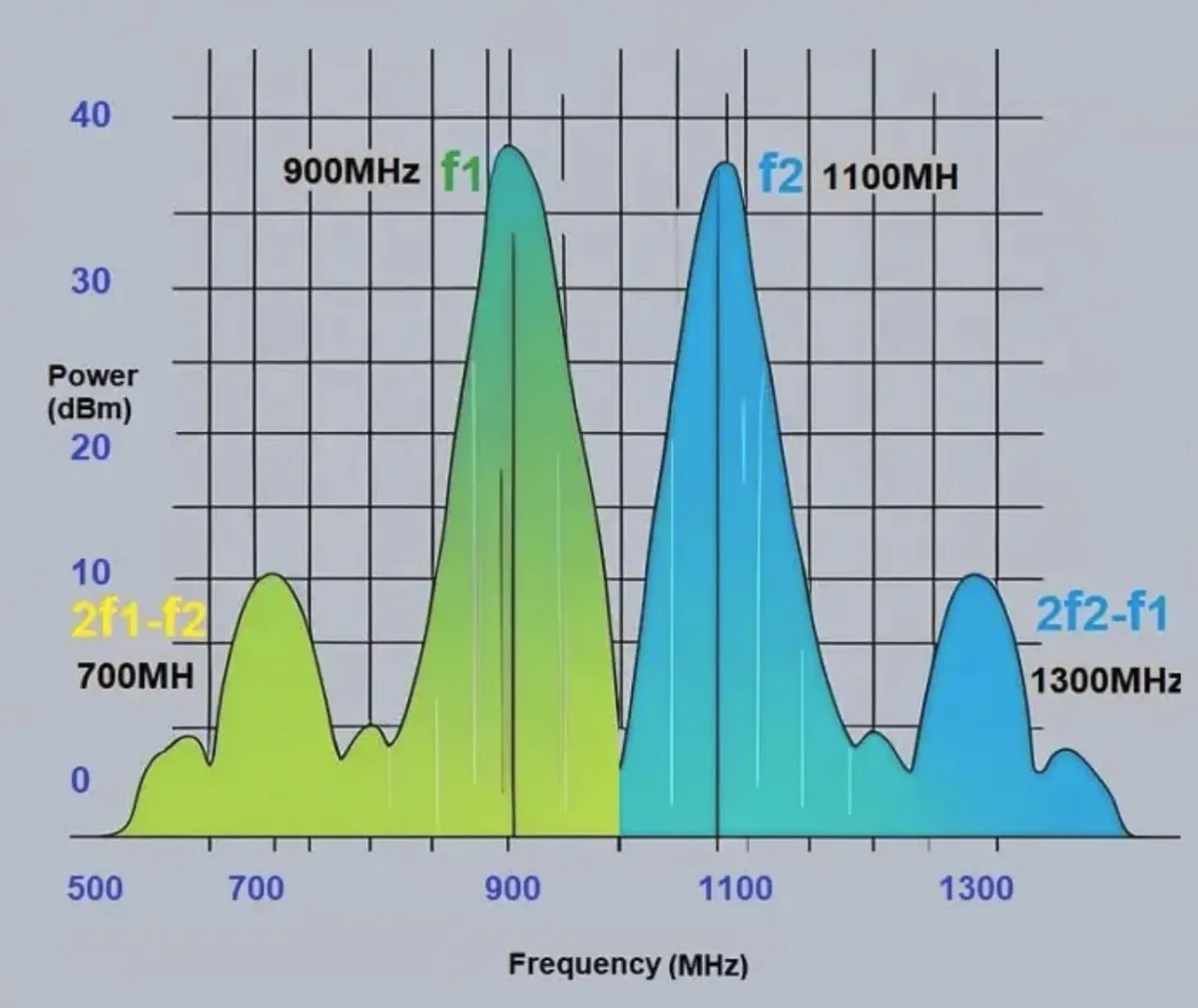
Feed 1000 Hz and 1100 Hz into a slightly nonlinear amplifier and you’ll get extra junk like:
- 900 Hz (2·1000 - 1100)
- 1200 Hz (2·1100 - 1000)
Plus:
- 100 Hz (difference)
- 2100 Hz (sum)
Now imagine this with music or voice. Thousands of frequencies interacting, every pair generating its own IMD products. The result is a harsh, muddy, “dirty” sound.
And here’s the key insight:
- Harmonic distortion is musically related, so it sometimes sounds “pleasant”.
- IMD is not musically related, so it sounds like grit, chaos, mess.
That’s why IMD is way more offensive to the ear.
Where it shows up in your workflow
Pure digital math is perfectly linear. So in your DAW itself, no IMD is happening.
But the moment you load anything that emulates analog:
- Tape emulation
- Tube preamp
- Saturator
- Compressor with “character”
you are introducing nonlinearity on purpose. Which means you are adding IMD on purpose.
And that’s the whole game. That “analog flavor” you love, that thickness, that vibe, comes with a bit of controlled chaos.
Want this on your own track?
I master more than 1,000 songs a year for artists and labels, from stems or a stereo mix. Send me your track and I'll tell you what it needs.
A new tip like this every week, free: join the newsletter.
Work with me
Whenever you're ready, here's how I can help.
 MentoringMix & Master AcceleratorWeekly video reviews of your tracks, live group calls, and the business side of a studio career.By applicationApply now
 Preset packFUSION150 hand-crafted Valhalla VintageVerb presets. Three clicks to the sound you already hear in your head.20€Get the pack
 CourseAdvanced MicrodynamicsFour hours on the micro-level movement that makes a mix feel alive. Joined by 220+ students.149€See the course
 CourseLow End MasteryKick and bass chemistry, so your low end lands on club rigs and earbuds alike. Joined by 500+ students.159€See the course
 SoftwareStudiOSThe software I run my own studio on: deliveries, client feedback, versions and invoices in one place.14 days freeTry StudiOS